Research Expertise
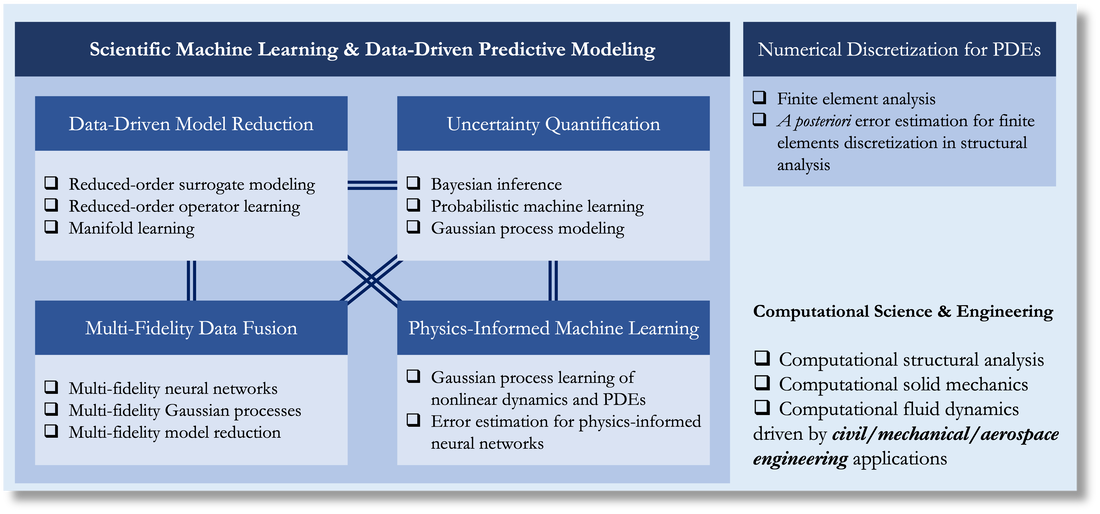
Publications
- T. J. Heeringa, C. Brune and M. Guo. Sparsifying dimensionality reduction of PDE solution data with Bregman learning. arXiv:2406.12672, 2024.
- N. Botteghi, P. Motta, A. Manzoni, P. Zunino and M. Guo. Recurrent deep kernel learning of dynamical systems. arXiv:2405.19785, 2024.
- D. Ye and M. Guo. Gaussian process learning of nonlinear dynamics. Communications in Nonlinear Science and Numerical Simulation, 138: 108184, 2024. DOI: 10.1016/j.cnsns.2024.108184
- P. Conti, M. Guo, A. Manzoni, A. Frangi, S. L. Brunton and J. N. Kutz. Multi-fidelity reduced-order surrogate modeling. Proceedings of the Royal Society A, 48: 20230655, 2024. DOI: 10.1098/rspa.2023.0655
- D. Ye and M. Guo. Bayesian approach to Gaussian process regression with uncertain inputs. arXiv:2305.11586, 2023.
- X. Xie, W. Wang, H. Wu and M. Guo. Data-driven analysis of parametrized acoustic systems in the frequency domain. Applied Mathematical Modelling, 124: 791-805, 2023. DOI: 10.1016/j.apm.2023.08.018
- L. Cicci, S. Fresca, M. Guo, A. Manzoni and P. Zunino. Uncertainty quantification for nonlinear solid mechanics using reduced order models with Gaussian process regression. Computers & Mathematics with Applications, 149: 1-23, 2023. DOI: 10.1016/j.camwa.2023.08.016
- P. Conti, M. Guo, A. Manzoni and J. S. Hesthaven. Multi-fidelity surrogate modeling using long short-term memory networks. Computer Methods in Applied Mechanics and Engineering, 404: 115811, 2023. DOI: 10.1016/j.cma.2022.115811
- N. Botteghi, M. Guo and C. Brune. Deep kernel learning of dynamical models from high-dimensional noisy data. Scientific Reports, 12: 21530, 2022. DOI: 10.1038/s41598-022-25362-4
- M. Guo, S. A. McQuarrie and K. E. Willcox. Bayesian operator inference for data-driven reduced-order modeling. Computer Methods in Applied Mechanics and Engineering, 402: 115336, 2022. DOI: 10.1016/j.cma.2022.115336
- M. Guo and E. Haghighat. Energy-based error bound of physics-informed neural network solutions in elasticity. Journal of Engineering Mechanics, 148(8): 04022038, 2022. DOI: 10.1061/(ASCE)EM.1943-7889.0002121; arXiv: 2010.09088
- M. Guo, A. Manzoni, M. Amendt, P. Conti and J. S. Hesthaven. Multifidelity regression using artificial neural networks: Efficient approximation of parameter-dependent output quantities. Computer Methods in Applied Mechanics and Engineering, 389: Article 114378, 2022. DOI: 10.1016/j.cma.2021.114378
- C. Bigoni, M. Guo and J. S. Hesthaven. Predictive monitoring of large-scale engineering assets using machine learning techniques and reduced order modeling. A. Cury et al. (eds.), Structural Health Monitoring Based on Data Science Techniques, Structural Integrity 21, Springer, 2021. DOI: 10.1007/987-3-030-81716-9_9
- M. Guo and C. Brune. Uncertainty quantification for physics-informed deep learning. W. H. A. Schilders (ed.), Mathematics: Key Enabling Technology for Scientific Machine Learning, Platform Wiskunder Nederland, 2021. link
- M. Guo. A brief note on understanding neural networks as Gaussian processes. arXiv:2107.11892, 2021.
- M. Kast, M. Guo and J. S. Hesthaven. A non-intrusive multifidelity method for the reduced order modeling of nonlinear problems. Computer Methods in Applied Mechanics and Engineering, 364: Article 112947, 2020. DOI: 10.1016/j.cma.2020.112947
- J. Yu, C. Yan and M. Guo. Non-intrusive reduced order modeling for fluid problems: A brief review. Proceedings of the Institution of Mechanical Engineers, Part G: Journal of Aerospace Engineering, 233(16): 5896-5912, 2019. DOI: 10.1177/0954410019890721
- Z. Zhang, M. Guo and J. S. Hesthaven. Model order reduction for large-scale structures with local nonlinearities. Computer Methods in Applied Mechanics and Engineering, 353: 491-515, 2019. DOI: 10.1016/j.cma.2019.04.042
- M. Guo and J. S. Hesthaven. Data-driven reduced order modeling for time-dependent problems. Computer Methods in Applied Mechanics and Engineering, 345: 75–99, 2019. DOI: 10.1016/j.cma.2018.10.029
- M. Guo and J. S. Hesthaven. Reduced order modeling for nonlinear structural analysis using Gaussian process regression. Computer Methods in Applied Mechanics and Engineering, 341: 807-826, 2018. DOI: 10.1016/j.cma.2018.07.017
- M. Guo and H. Zhong. Strict upper and lower bounds for quantities of interest in static response sensitivity analysis. Applied Mathematical Modelling, 49: 17-34, 2017. DOI: 10.1016/j.apm.2017.04.029
- M. Guo and H. Zhong. Equivalence of two strictly bounding approaches for goal-oriented error estimation. Journal of Tsinghua University, Science and Technology, 57(4): 362–368, 2017. (in Chinese)
- M. Guo and H. Zhong. Constitutive-relation-error-based a posteriori error bounds for a class of elliptic variational inequalities. Applied Mathematics Letters, 71: 14-23, 2017. DOI: 10.1016/j.aml.2017.03.007
- M. Guo, W. Han and H. Zhong. Legendre-Fenchel duality and a generalized constitutive relation error. arXiv:1611.05589, 2016.
- M. Guo and H. Zhong. Weak form quadrature solution of 2mth-order Fredholm integro-differential equations. International Journal of Computer Mathematics, 93(10), 1650-1664, 2016. DOI: 10.1080/00207160.2015.1070839
- M. Guo, H. Zhong and K. You. A second-order perturbation method for fuzzy eigenvalue problems. Engineering Computations, 33(2): 306-327, 2016. DOI: 10.1108/EC-01-2015-0024
- M. Guo and H. Zhong. Identification of imperfections in thin plates based on the modified potential energy principle. Mechanics Research Communications, 72: 16-23, 2016. DOI: 10.1016/j.mechrescom.2016.01.001
- M. Guo and H. Zhong. Goal-oriented error estimation for beams on elastic foundation with double shear effect. Applied Mathematical Modelling, 39(16): 5047-5057, 2015. DOI: 10.1016/j.apm.2015.04.021
- L. Wang, M. Guo and H. Zhong. Strict upper and lower bounds of quantities for beams on elastic foundation by dual analysis. Engineering Computations, 32(6): 1619-1642, 2015. DOI: 10.1108/EC-04-2014-0094
- M. Guo. Mathematical equivalence of the integration method and the unit load method. Mechanics in Engineering, 35(4): 70-72, 2013. (in Chinese)
Presentations at Academic Events
Contribution to Conferences and Workshops
Invited Seminars
- The 9th European Congress on Computational Methods in Applied Sciences and Engineering | Lisbon, Portugal | Jun. 2024
- SIAM Conference on Uncertainty Quantification 2024 | Triest, Italy | Feb. 2024
- The 10th International Congress on Industrial and Applied Mathematics (ICIAM 2023) | Tokyo, Japan | Aug. 2023
- Math 2 Product (M2P) Conference 2023 | Taormina, Italy | May 2023
- SIAM Conference on Computational Science and Engineering 2023 | Amsterdam, the Netherlands | Feb. 2023
- SIAM Conference on Mathematics of Data Science 2022 | San Diego, CA, United States | Sept. 2022
- 4TU.AMI networking summer event | Eindhoven, The Netherlands | Jul. 2022
- The 1st Dutch National workshop of AI and Mathematics | Amsterdam, The Netherlands | Jun. 2022
- The 8th European Congress on Computational Methods in Applied Sciences and Engineering | Oslo, Norway | Jun. 2022
- Lorentz Center workshop: Computational Mathematics and Machine Learning | Leiden, The Netherlands | Nov. 2021
- Mechanistic Machine Learning and Digital Twins for Computational Science, Engineering and Technology Conference | San Diego, U.S. | Sept. 2021
- SIMAI Congress 2020+2021 | Parma, Italy | Aug. 2021
- 16th U.S. National Congress on Computational Mechanics | virtual | Jul. 2021
- SIAM Conference on Computational Science and Engineering 2021 | virtual | Mar. 2021
- XV International Conference on Computational Plasticity, Fundamentals and Applications | Barcelona, Spain | Sept. 2019
- 3rd International Conference on Uncertainty Quantification in Computational Sciences and Engineering | Crete, Greece | Jun. 2019
- SIAM Conference on Computational Science and Engineering 2019 | Spokane, USA | Feb. 2019
- EUROMECH Colloquium 597: Reduced order modeling in mechanics of materials | Bad Herrenalb, Germany | Aug. 2019
- SIAM Conference on Uncertainty Quantification 2018 | Los Angeles, USA | Apr. 2018
- Half-day Workshop: Reduced order modeling for engineering systems | Zurich, Switzerland | Mar. 2018
- SIAM Conference on Computational Science and Engineering 2017 | Atlanta, USA | Feb. 2017 (Poster)
- Chinese Conference on Computational Mechanics in conjunction with International Symposium on Computational Mechanics | Hangzhou, China | Oct. 2016
- The 12th World Congress on Computational Mechanics | Seoul, South Korea | Jul. 2016
- The 12th Academic Annual Conference of Beijing Society of Theoretical and Applied Mechanics | Beijing, China | Jan. 2013
Invited Seminars
- Numerical Analysis Seminar, Centre for Mathematical Sciences, Lund University | Lund, Sweden | May 2024
- Data-Driven Physical Simulation (DDPS) webinar, Lawrence Livermore National Laboratory | vitural | Nov. 2023
- Scientific Machine Learning and Dynamical Systems autumn school, CWI | Amsterdam, the Netherlands | Oct. 2023
- 'A Day in Artificial Intelligence and Dynamical Systems', Politecnico di Milano | Milan, Italy | Jul. 2023
- Mathematics Departmental Colloquium, City University of Hong Kong | virtual | May 2023
- NHR4CES Community Workshop 2023: Machine Learning in Computational Fluid Dynamics | virtural | Feb. 2023
- Mathematics of Data Science seminar, University of Twente | Enschede, the Netherlands | Jan. 2023
- DL-ROM group seminar, MOX-Politecnico di Milano | Milan, Italy | Nov. 2022
- Numerical Analysis Seminar, University of Iowa | Iowa City, IA, United States | Aug. 2022
- Digital Society Institute seminar, University of Twente | Enschede, The Netherlands | Jun. 2022
- AI for Science Institute internal seminar | Beijing, China | May 2022
- DIAM Seminar in Numerical Analysis, Delft University of Technology | Delft, The Netherlands | Jan. 2022
- MOX-Politecnico di Milano internal seminar | Milan, Italy | Oct. 2021
- NDNS+ Twente workshop | virtual| Jun. 2021
- CASA Colloquium, Eindhoven University of Technology | Eindhoven, The Netherlands | May 2021
- DAMUT Colloquium, University of Twente | Enschede, The Netherlands | Apr. 2021
- School of Mechanics, Civil Engineering and Architecture, Northwestern Polytechnical University | Xi’an, China | Mar. 2021
- Key Laboratory of Fluid Mechanics - Ministry of Education, Beihang University | Beijing, China | Jan. 2019.
- Department of Civil Engineering, Tsinghua University | Beijing, China | Dec. 2018
- College of Mathematical Science, Ocean University of China | Qingdao, China | Aug. 2018